
The Difference Between A Dip And A Falling Knife Has Nothing To Do With The Chart
The rule is correct, but the way most people explain it puts the entire burden on the chart when the entire burden actually belongs on the buyer
Every crypto investor has heard the rule about buying the dip versus catching the falling knife. It shows up in every Twitter thread, every YouTube video, every podcast, every conversation between people who hold bitcoin and people who do not understand why anyone would. The rule is everywhere, and most people who quote it believe they understand it, because the rule sounds obvious. You buy when something has dropped a reasonable amount. You do not buy when something is in free fall. Wait for the bottom. Catch the dip, not the knife.
The problem with the standard version of this advice is that it puts the entire burden of the distinction on the asset, when in reality the entire burden of the distinction is on the buyer.
Let me explain what I mean, because once this reframe lands it becomes nearly impossible to look at a drawdown the same way again.
The standard advice tells you that a dip is something you can identify on a chart. A correction of a healthy amount. A pullback to a support level. A retracement that looks orderly. A falling knife, by contrast, is also something you can identify on a chart. A vertical decline. A capitulation candle. A cascading break of every level the technical analysts said would hold. The implication is that if you become better at reading charts, you can tell the difference between the two in real time.
This is wrong, and I think it has cost the retail crypto investor more money than almost any other piece of conventional wisdom in the industry.
The chart cannot tell you whether a drawdown is a dip or a falling knife, because the chart does not know how you are going to behave after you enter the position. And how you behave after you enter the position is the entire variable that determines which of the two things you just bought.
Think about this from the other direction. Two investors buy bitcoin on the same day at the same price, both after a 30% drawdown from the highs, both believing they are buying the dip. Two weeks later, bitcoin is down another 25% from where they bought. The first investor looks at the new lower price and feels excited. His thesis has not changed. He has dry powder. He adds. Six months later, the asset has recovered, and the second add became the most profitable trade of his year.
The second investor looks at the new lower price and panics. He cannot sleep. He pulls up Twitter and finds twenty accounts telling him this time is different. He sells at a loss. Six months later, the asset has recovered, and his sale near the local low became the most expensive trade of his year.
Same asset. Same entry price. Same drawdown after the entry. One investor caught the dip. The other caught the falling knife. The difference was not the chart. The difference was the buyer.
The honest version of the rule is this. A dip is a drawdown that your behavior survives. A falling knife is a drawdown that your behavior does not survive. The asset is the same asset in either case. The price action is the same price action. What changes is whether the buyer has built the kind of relationship with the position that lets him stay rational while the price moves against him, or whether the buyer has built the kind of relationship with the position that produces panic and capitulation.
If you have not built the first kind of relationship, no amount of chart reading is going to save you. You will identify what you believe is a dip, you will buy it, the price will continue to fall, your behavior will collapse, you will sell at a loss, and you will tell yourself afterward that you got unlucky and caught a falling knife. You did not catch a falling knife. You caught a dip and then you turned it into a falling knife with your own behavior.
Here is the framework I actually use to decide whether I am looking at a dip or a falling knife, and it has nothing to do with the chart.
Can I name the thesis without checking my notes?
If the answer is no, this is not a dip. This is a position I do not understand well enough to hold through a drawdown. Setting a bid on something whose thesis I cannot articulate is gambling, regardless of how good the chart looks. If I cannot tell you in two sentences why I want to own this asset over a five-year horizon, I should not be adding to it on a red day. I should not own it at all.
Is my thesis still true, or has the thesis changed?
This is the question that separates a real dip from a real falling knife better than any chart analysis ever could. If the underlying thesis is still intact, the drawdown is noise. Add. If the underlying thesis has changed in a way I should care about, the drawdown is information. Reduce.
Is my position size still right for this lower price?
Lower prices mechanically reduce the dollar size of your position. If you were comfortable with $50,000 of bitcoin exposure and bitcoin is now 30% lower, your exposure is now $35,000 even if you have not sold a single coin. Adding to bring it back to your original target is not a bullish call on the asset. It is portfolio maintenance. The investor who does this mechanically, without emotion, captures the dislocation without having to be brave.
Do I have dry powder I committed in advance to deploying at this price?
This is the question that separates investors who buy correctly from investors who watch dislocations happen without participating in them. If you have pre-committed capital to deploy at lower prices, lower prices are an event you are prepared for. If you do not, lower prices are an event that catches you flat-footed and triggers the second-guessing that produces panic. The discipline is not knowing where the bottom is. The discipline is having capital staged at lower levels regardless of where the bottom turns out to be.
Am I going to feel sick adding more, or am I going to feel relieved?
This is the gut check that I use as the final filter, and it sounds soft but it is the most reliable of the five. If adding to a position at a lower price fills you with dread, your size is already too big. You are sized for the upside scenario and you cannot tolerate the downside. Reduce, do not add. If adding fills you with relief, you are sized correctly and your psychology is calibrated for the long arc. Add. The gut is doing real work here, and learning to listen to it is one of the most underrated skills in this asset class.
If you can answer those five questions cleanly, what you are looking at is a dip. You should add. If you cannot answer them cleanly, what you are looking at is a falling knife. You should not add, regardless of what the chart says, regardless of what your favorite accounts are saying, regardless of how attractive the price looks relative to the recent highs.
The falling knife is not in the asset. The falling knife is in the gap between what you can articulate and what you cannot, what you have prepared for and what you have not, what you can tolerate and what you cannot.
The investors who consistently buy correctly during corrections are not the ones with better technical analysis. They are the ones with better self-knowledge. They have done the honest work of figuring out what they can hold, what they can add, and what they need to leave alone, before the drawdown ever arrives. When the drawdown does arrive, the work is already done. The bids are already set. There is no decision to make in the moment, because the moment is just the execution of a process that was designed in calmer hours.
A lot of you are sitting at your screen right now trying to figure out whether what you are looking at is a dip you should be adding to or a falling knife you should be backing away from. The chart cannot tell you. The macro cannot tell you. The only thing that can tell you is the conversation you have not had with yourself about whether your thesis is still intact, your size is still right, and your psychology is still capable of holding what you currently hold without flinching.
If yes, this is a dip and you should be excited about lower prices. If no, this is a falling knife and you should reduce before adding, regardless of where the chart goes from here. The work is the same either way. The work is the work on yourself, not the work on the chart.
That is the entire game.

Bitcoin Thoughts And Analysis
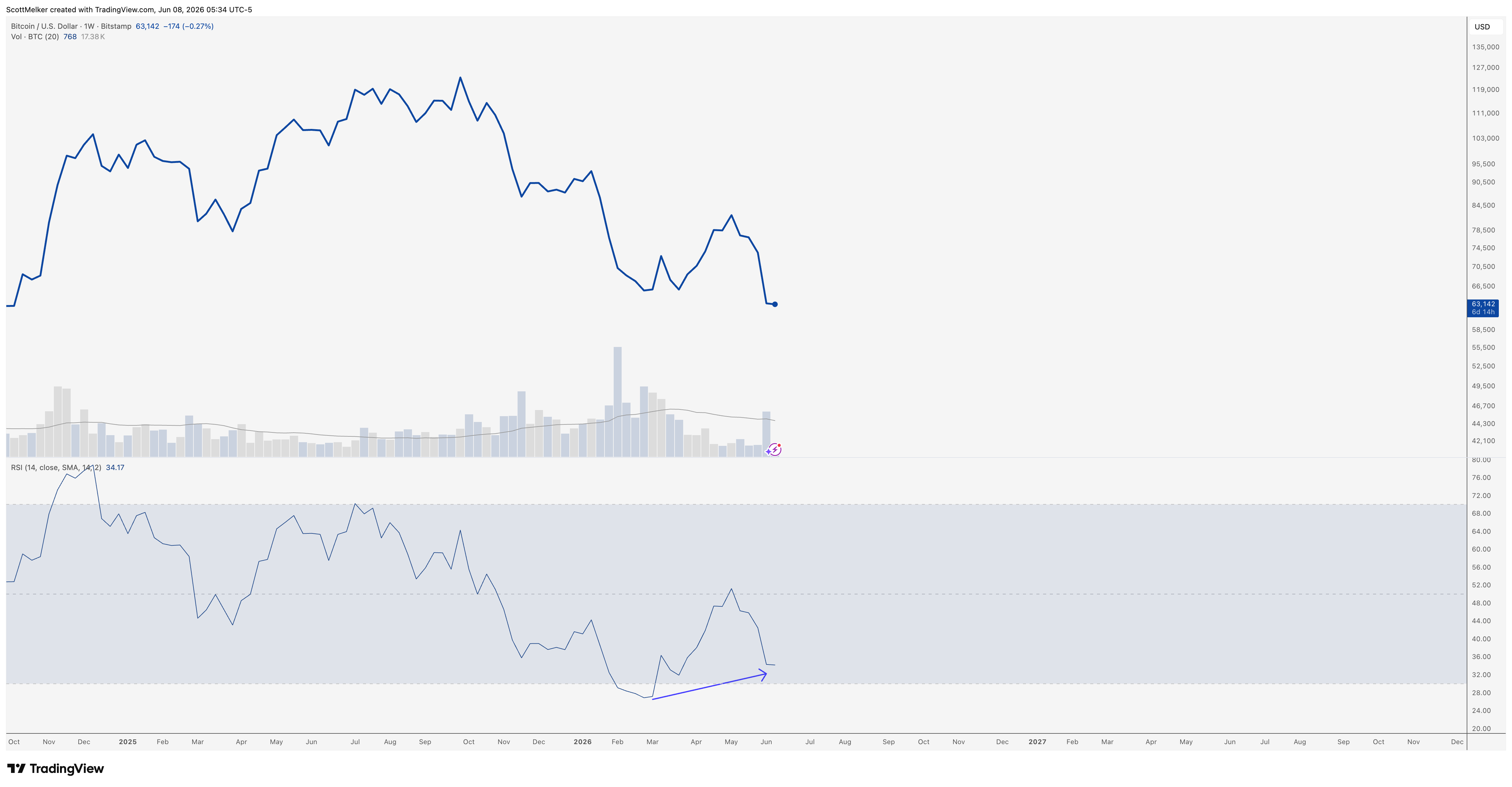
We have potential bullish divergence coming out of oversold RSI, as I said was likely last week when I made the case for Bitcoin bottoming. We need this week to close with a clear elbow up on price and RSI.
If this happens, we have the second confirmed bullish divergence ever on the weekly chart - the first was FTX.
This is only the 4th time it has hit oversold on the weekly chart.

Coinbase Launches Equity Perpetual Futures Today
Coming June 8: Perpetual-Style Equity Index Futures
The first perpetual-style equity index futures on a US-regulated exchange go live today. Four contracts cover AI, China, defense, and Nasdaq exposure. Cash-settled, CFTC-regulated, hourly funding rates. Crypto market structure just showed up in regulated equities, exactly where capital is rotating.
House GOP Wants To Ban Lawmakers From Prediction Markets
Bryan Steil seeks prediction market ban for lawmakers
Representative Steil announced Thursday he wants prediction market restrictions added to HR 7008, the lawmaker stock trading ban. The bill would extend insider-trading scrutiny to Polymarket and Kalshi. Sports stays legal. Elections and policy do not. The political price discovery industry just got Washington’s attention.
Hyperliquid Just Released $700 Million Of HYPE Into The Market
A scheduled vesting unlock pushed roughly $700 million of HYPE into circulation Saturday, contributing to a 12% weekly drop in the token. Token unlocks are mechanical supply shocks the price action coverage almost always ignores. Calendar matters more than narrative on weeks like this one.

Why Bitcoin Is “Preeminent” In The Biggest Macro Trade Ever - Dan Tapiero
My Platforms And Sponsors
Arch Public - It’s a hedge fund in your pocket. Built for retail traders, designed to outperform Wall Street. Try emotionless algorithmic trading at Arch Public today.
Promote your brand with The Wolf of All Streets. For sponsorship and partnership opportunities, contact info@thewolfofallstreets.io.
The Wolf Pack - My Telegram group where I share daily market updates, real-time observations, and ongoing discussions with the community. There’s a dedicated channel and group chat, and it’s completely free to join.
X - I spend most of my time on X, contributing to CryptoTownHall every weekday morning, sharing random charts, and responding to as many of you as I can.
YouTube - Home of the Wolf Of All Streets Podcast and daily livestreams. Market updates, charts, and analysis!
The views and opinions expressed here are solely my own and should in no way be interpreted as financial advice. Every investment and trading move involves risk. You should conduct your own research when making a decision. I am not a financial advisor. Nothing contained in this e-mail constitutes or shall be construed as an offering of financial instruments or as investment advice or recommendations of an investment strategy or whether or not to "Buy," "Sell," or "Hold" an investment.
Thanks for reading The Wolf Den! Subscribe for free to receive new posts and support my work.