
NFTs Walked So Tokenized Equities Could Run
The speculative mania around digital art faded, but the infrastructure behind on-chain ownership never stopped evolving.
In March of 2021, a collage of digital images created by an artist named Beeple sold at Christie’s for a record-smashing $69 million. The buyer did not receive a sculpture, a painting, or even a physical object to hang on a wall. What they received instead was a token on the Ethereum blockchain representing ownership of a digital file.
Within months, celebrities like Justin Bieber, Jimmy Fallon, Snoop Dogg, and Steph Curry were buying Bored Ape Yacht Club NFTs and using them as social media profile pictures. OpenSea’s monthly trading volume exploded from under $100 million in early 2021 to more than $3 billion by August of that same year, while individual NFT collections were suddenly commanding valuations comparable to major traditional art auctions.
At the time, it looked like the internet had collectively lost its mind, but in hindsight, the NFT boom may have been Wall Street’s first real glimpse into what tokenized ownership could eventually become.
Today’s Newsletter Is Brought To You By Ledn
Better Rates. Same Gold-Standard Protection
Ledn has introduced their lowest rates ever. No complexity, no fine print. The larger the loan, the lower the rate.
These new rates apply to all new loans, refinances, and renewals. You’ll see all the rates upfront, before you apply.
The new, lower rates come with Ledn’s gold standard protection.
Your bitcoin remains custodied and is never lent out for interest.
Perfect 8 year track record of keeping clients assets safe
Auto top-up, LTV alerts, and partial repayments to keep you in control
Repay whenever you want—with zero penalties or monthly payments
Ledn’s perfect $10B+ track record through every market cycle in the last eight years speaks for itself.
Don’t choose between a great rate and the safety of your bitcoin. Get both at Ledn.
Check out your rate by using their loan calculator at ledn.io.
In 2021, the financial world could not decide whether it was witnessing the future of digital ownership or one of the strangest speculative bubbles the internet had ever produced.
Most people remember what happened next: NFT prices collapsed, trading volumes evaporated, and the hype that once dominated headlines slowly turned into a punchline. Celebrities who had spent hundreds of thousands of dollars on NFTs became targets of endless “right-click save” jokes from critics who saw the entire market as absurd. To many outsiders, the experiment came to look like a temporary internet fever dream fueled by overpriced JPEGs, celebrity speculation, and excess liquidity.
But beneath the mania, something much more important had subtly taken place. Millions of people had just been introduced to the idea that ownership itself could live on-chain. And while the collectibles boom eventually cracked, the infrastructure, legal frameworks, trading rails, and institutional interest surrounding tokenized ownership never actually disappeared. In many ways, Wall Street is now picking up where the NFT era left off.
Introducing tokenized equities.
My suspicion with the entire NFT boom and bust is that it gave Wall Street an up close and personal look at what blockchain-based ownership systems could eventually do for traditional financial assets. Once millions of people proved they were willing to buy, trade, custody, and transfer digital assets entirely on-chain, it became easier to imagine applying the same infrastructure to assets institutions already understand: stocks, bonds, money market funds, private credit, and real estate.
That transition is already underway. Over the past two years, firms like BlackRock, Franklin Templeton, and Apollo Global Management have all moved deeper into tokenized finance, while tokenized U.S. Treasuries have quietly grown into a market approaching $14 billion in size. Instead of tokenizing digital art collections, institutions are now experimenting with putting real financial instruments directly onto blockchain networks like Ethereum.
The basic idea behind tokenized equities is relatively simple: take a traditional stock and represent ownership of it through blockchain-based tokens that can move across digital networks much more efficiently than legacy financial rails. In theory, that could allow for faster settlement, around-the-clock trading, greater global access, easier collateral movement, and eventually the ability for financial assets to interact directly with decentralized applications and smart contracts. What began during the NFT era as an experiment in digital collectibles is increasingly evolving into a much broader experiment around rebuilding financial infrastructure itself.
With all this said, a fair question right now is: when does this actually become real for everyday investors? While serious progress is clearly being made behind the scenes, most people are still not trading tokenized Tesla shares for tokenized Amazon shares and instantly moving the proceeds into Ethereum or stablecoins. The technology, regulation, and market structure simply are not fully there yet, at least not in the United States.
One area where I do think the technology has already started to feel genuinely useful is tokenized gold, which is something I have personally used and come to appreciate. For example, OKX offers Tether Gold (XAUT), a token backed by physical gold that can be traded and transferred across crypto markets almost as easily as a stablecoin. (XAUT can also be found on Binance, Bitget, Uniswap, and several other exchanges.)
What makes products like this one so interesting is the convenience factor. Instead of needing to wire money out to a brokerage account, wait for market hours, or move through multiple financial intermediaries, users can rotate between crypto, stablecoins, and tokenized gold almost instantly from the same platform. It starts to hint at what tokenized finance could eventually look like if the concept expands successfully into equities, bonds, and other traditional financial assets.
Part of the challenge in all this is that tokenized equities sit directly in the middle of one of the most heavily regulated areas of finance. Unlike NFTs, which largely operated in a legal gray zone during their boom, tokenized stocks involve securities laws, transfer restrictions, custody requirements, broker-dealer licensing, and questions around how on-chain ownership legally maps back to actual shareholder rights. In many cases today, what users are really interacting with is a tokenized representation of exposure to an asset, rather than the underlying equity itself living fully on-chain.
Still, momentum is building faster than many people realize. Robinhood has openly discussed tokenized securities and has already done so in Europe, Coinbase has pushed for clearer rules around blockchain-based equities, and firms like Kraken and Bybit have explored offering tokenized stock products to non-U.S. users. At the same time, tokenized treasuries, stablecoins, and on-chain money market funds are already functioning as early proof-of-concept versions of blockchain-native finance, giving institutions a way to experiment with settlement, liquidity, and collateral movement before fully bringing equities on-chain.
In other words, tokenized equities may not arrive all at once in some dramatic overnight moment. The transition will likely be slow and uneven, with pieces of the traditional financial system steadily migrating onto blockchain rails, one market segment at a time. But the technology is advancing nonetheless, and in many ways, the NFT boom and bust helped clear the path by giving both retail users and institutions their first real experience with tokenized ownership at scale.

BlackRock Expands Tokenized Treasuries On Ethereum
BlackRock is expanding deeper into crypto finance by seeking approval to tokenize shares of a roughly $6.1 billion Treasury liquidity fund on Ethereum. The product is aimed at stablecoin holders, offering a way to earn regulated yield on idle digital dollars without moving back into the traditional banking system. The filing also signals how quickly tokenized Treasuries are growing, as major financial firms increasingly use blockchain networks for real-world assets, collateral, and cash management.
South Korean Crypto Holdings Fall Nearly 50% In One Year
This is the kind of headline that tends to come up very regularly during bear markets, when falling prices and weak sentiment push retail investors toward safer or more familiar assets. South Korean crypto holdings were cut nearly in half over the past year as trading activity collapsed and capital rotated into the stock market instead. At the same time, regulators are preparing tighter AML rules and a future 22% crypto tax, adding even more pressure to an already cooling market.
Clarity Markup Is This Thursday!
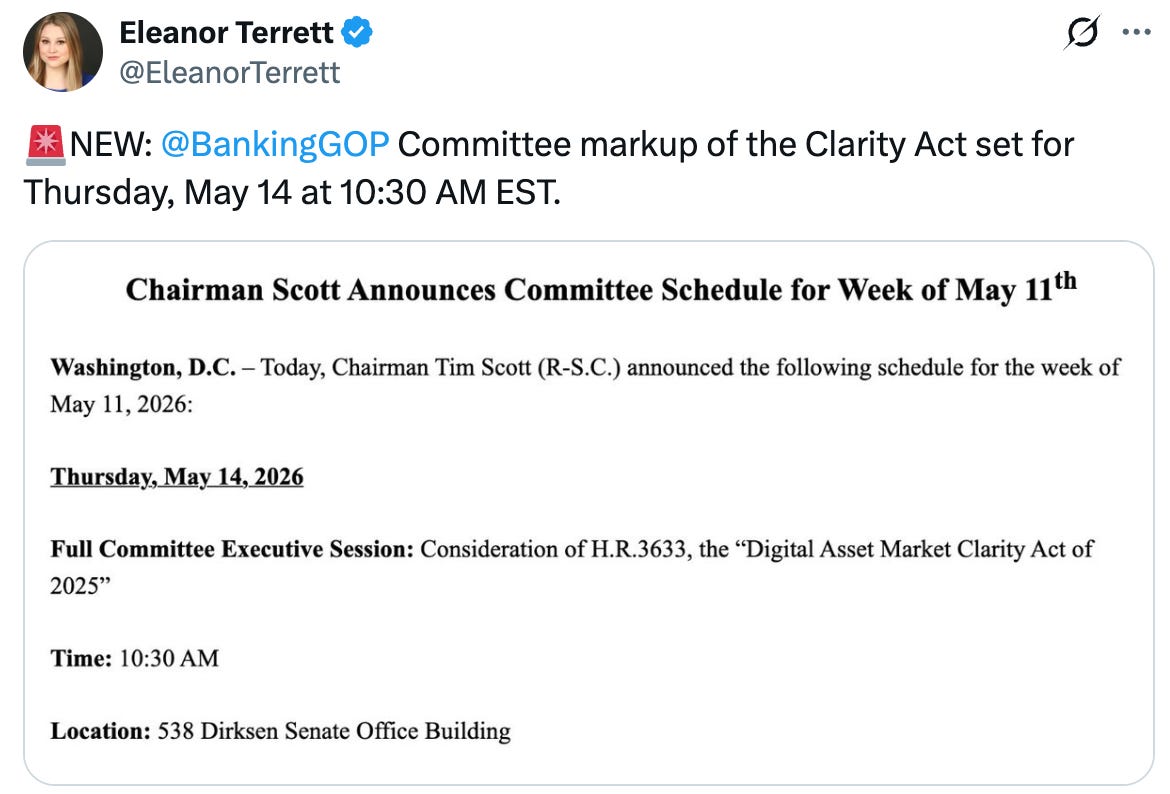
The Senate Banking Committee has officially scheduled a markup of the Digital Asset Market Clarity Act for Thursday, May 14, at 10:30 AM EST, marking one of the most significant regulatory steps forward for crypto market structure legislation so far. The move follows reports that draft legislative text had already been circulating among industry participants ahead of the vote. If advanced, the bill would push the broader crypto regulatory framework deeper into the formal congressional process.

Bitcoin Bombshell: Saylor Reveals When He Would Sell - EXCLUSIVE
Michael Saylor has said “never sell your Bitcoin” for years - but in this exclusive interview at Consensus in Miami, he told me why that’s changing. Strategy now holds 818,000 Bitcoin worth $65 billion, and Saylor explains why signaling a willingness to sell is actually critical to protecting the asset’s value on their balance sheet. But here’s the twist: for every Bitcoin they sell, they’re buying back 5 to 10x more in the same month. He also breaks down how STRC has exploded from zero to $8.5 billion in eight months, why DeFi builders are already tokenizing it into yield coins, and how digital credit could reshape the entire crypto ecosystem. This is the conversation Wall Street and crypto Twitter need to hear.
My Platforms And Sponsors
Arch Public - It’s a hedge fund in your pocket. Built for retail traders, designed to outperform Wall Street. Try emotionless algorithmic trading at Arch Public today.
Promote your brand with The Wolf of All Streets. For sponsorship and partnership opportunities, contact info@thewolfofallstreets.io.
The Wolf Pack - My Telegram group where I share daily market updates, real-time observations, and ongoing discussions with the community. There’s a dedicated channel and group chat, and it’s completely free to join.
The Crypto Advisor - My weekly newsletter for registered investment advisors, combining macro trends, Wall Street insights, and crypto – all in one place..
X - I spend most of my time on X, contributing to CryptoTownHall every weekday morning, sharing random charts, and responding to as many of you as I can.
YouTube - Home of the Wolf Of All Streets Podcast and daily livestreams. Market updates, charts, and analysis!
The views and opinions expressed here are solely my own and should in no way be interpreted as financial advice. Every investment and trading move involves risk. You should conduct your own research when making a decision. I am not a financial advisor. Nothing contained in this e-mail constitutes or shall be construed as an offering of financial instruments or as investment advice or recommendations of an investment strategy or whether or not to "Buy," "Sell," or "Hold" an investment.
Thanks for reading The Wolf Den! Subscribe for free to receive new posts and support my work.