
Miner Capitulation Just Fired, And Half The Miners Have Already Left The Business
Bitcoin's mining difficulty just had its eleventh-largest drop in history, which has historically been a cycle-bottom signal.
Bitcoin’s mining difficulty fell by ten point zero nine percent on Saturday, the eleventh-largest single downward adjustment in the network’s seventeen-year history. It was the third major drop in 2026 alone, following negative adjustments of eleven point one six percent in February and seven point seven six percent in March. The miner capitulation signal that has historically marked the bottom of a Bitcoin cycle has now fired, and the financial press is treating it as the latest piece of evidence that the worst of this drawdown is behind us.
I want to walk through this carefully because the historical record on capitulation as a bottoming indicator is strong, the current signal is real, and the structural story underneath this particular cycle is different from every prior one in a way that matters for what comes next.
Start with the historical record.
The largest downward difficulty adjustment in Bitcoin’s history happened in July 2021, when China’s mining ban forced large portions of the global hashrate offline almost overnight. The adjustment came in at negative twenty seven point nine four percent. Bitcoin was trading around thirty three thousand dollars in the days following. Four months later, Bitcoin printed an all-time high near sixty nine thousand. That is a one hundred ten percent rally from the post-capitulation level to the cycle peak, all in the four months immediately following the largest miner capitulation in Bitcoin’s history.
Watch The Daily Wolf With Phong Le
Phong Le, the CEO of Strategy, joined me on The Daily Wolf this week to walk through every myth, narrative, and doomer thesis the market has been throwing at the company. We covered the leverage stack, the mNAV question, the dilution argument, the alleged forced selling, and how the capital allocation machine actually works. After spending most of last week writing about Strategy from the outside in this newsletter, this is the conversation with the company itself - the answers from the seat that matters.
The second relevant precedent is December 2022, the bottom of the FTX-driven bear market. Bitcoin was trading around sixteen thousand dollars. The network registered a roughly ten percent downward difficulty adjustment as older-rig operators were squeezed below break-even and powered down. The capitulation signal fired. Bitcoin then rallied roughly four times that level over the following eighteen months, eventually printing new all-time highs in early 2024.
VanEck published research in December noting that Bitcoin has historically posted positive ninety-day forward returns sixty five percent of the time when hashrate is shrinking. During the 2018 bear cycle, miner capitulation lasted seventy two days and was followed by a three hundred percent rally. The pattern is not perfect. Capitulation is not sufficient on its own. But the base rate strongly favors bullish forward returns once the signal has fired.
That is the case for treating Saturday’s adjustment as a meaningful bottom signal. Now let me walk through the part of the story that is genuinely different this cycle.
The biggest publicly traded Bitcoin miners are not pivoting to survive the squeeze. They are pivoting out of the business.
IREN Limited, formerly Iris Energy, has executed the most aggressive transition of any miner in the public markets. The company signed a five-year, nine point seven billion dollar AI cloud contract with Microsoft last November and has since stacked additional multi-billion-dollar agreements with NVIDIA and Dell to support the buildout. IREN currently holds zero bitcoin. It is no longer a Bitcoin miner. It is an AI infrastructure operator that retains some legacy mining revenue while the transition completes.
Core Scientific announced in April that it is converting three hundred megawatts of bitcoin mining capacity at its Pecos, Texas campus into AI infrastructure. To fund the transition, Core Scientific sold one hundred seventy five million dollars worth of Bitcoin in March, dropping its holdings from two thousand five hundred thirty seven coins down to roughly six hundred thirty.
Hut 8 told investors on its fourth quarter earnings call that bitcoin is no longer a long-term strategic focus for the company. MARA Holdings, which has been the loudest HODL advocate among public miners for years, softened its stance and now sells newly mined bitcoin opportunistically, with roughly twenty eight percent of its holdings either loaned or pledged. CleanSpark said on its Q1 2026 earnings call that Bitcoin mining investment does not make a lot of sense at current hashprices compared to the returns available in AI infrastructure.
Across Core Scientific, Bitdeer, Riot Platforms, and Bitfarms alone, public miners have sold roughly fifteen thousand bitcoin from their treasury holdings since the start of the year, with the proceeds going almost entirely to fund AI pivots. The miners are not just shutting down rigs because they can no longer afford to run them. They are shutting down rigs because they have found something they would rather do with the power.
The honest complication on top of this is Texas 4CP season. The four-coincident-peak mechanism in Texas creates a strong incentive for large ERCOT consumers, which includes most of the major US-based public miners, to voluntarily curtail during the four peak summer demand intervals because those four intervals set transmission costs for the following year. The 4CP season began in June. TheEnergyMag and others have noted that the recent hashrate rebound suggests some of the early June reduction may have been temporary curtailment rather than permanent shutdown. So a portion of what looks like capitulation in the data is in fact rational seasonal optimization by miners who plan to come back online the moment the peak demand windows close. The actual capitulation signal is buried inside a noisier dataset than usual.
So what does it all add up to?
The honest read is that Saturday’s drop is composed of real capitulation by smaller operators squeezed below break-even, seasonal Texas curtailment that is temporary, and structural exit from the business by the largest public miners reallocating to AI. The first two are reversible. The third is not.
For the bottom thesis, this composition is actually more bullish than a pure capitulation read would be.
A pure capitulation cycle leaves the same miner base behind, smaller and more efficient. When the price recovers, those miners turn back on and the next cycle ratchets hashrate back up. A structural exit cycle removes capacity permanently. The megawatts that IREN converted to a multi-year Microsoft lease are not coming back to Bitcoin mining. The Core Scientific Pecos buildout is the same story. Every public miner that retasks a gigawatt of power to AI is permanently reducing the long-term supply pressure on Bitcoin’s price from new issuance, because the bitcoin those miners would have produced over the next decade will not be produced by them.
The marginal seller of newly-mined bitcoin in a hypothetical 2027 to 2028 bull market is going to be a smaller and more concentrated set of operators than it was in 2024 to 2025. The miners who remain will be the ones who deliberately chose to stay in the business after observing the AI alternative, which selects for the structural HODLers and the operators with the lowest cost basis.
I want to be honest that this is a structural argument, not a short-term call. Capitulation has historically marked cycle lows. The current capitulation is real on the smaller-operator end. Bernstein projected a sixty thousand dollar bottom range and we are inside that range. Standard Chartered’s Geoffrey Kendrick called the cycle low in on Friday. Spot ETF flows turned positive Friday for the first time in two weeks. These are all consistent signals that the cyclical bottom may be in. The AI pivot story does not contradict any of them. It adds a separate piece of structural support underneath them.
What you should watch from here is whether the hashrate recovers in the next two-week epoch. If most of the drop was Texas curtailment, hashrate will rebound quickly and the next adjustment around June 27 will be flat or positive. If the recovery is partial and slow, genuine capitulation is doing real work. Either outcome is consistent with the AI pivot accelerating. The Texas story is short-term noise. The AI pivot is the durable signal.
Capitulation has fired. The base rate says positive forward returns ninety days out. The miners not capitulating are leaving the business by choice. The supply picture is structurally tighter going forward than at any prior cycle bottom. The bull case for bitcoin from these levels is not a price prediction. It is a structural setup.
I’ll see you tomorrow.

Bitcoin Thoughts And Analysis
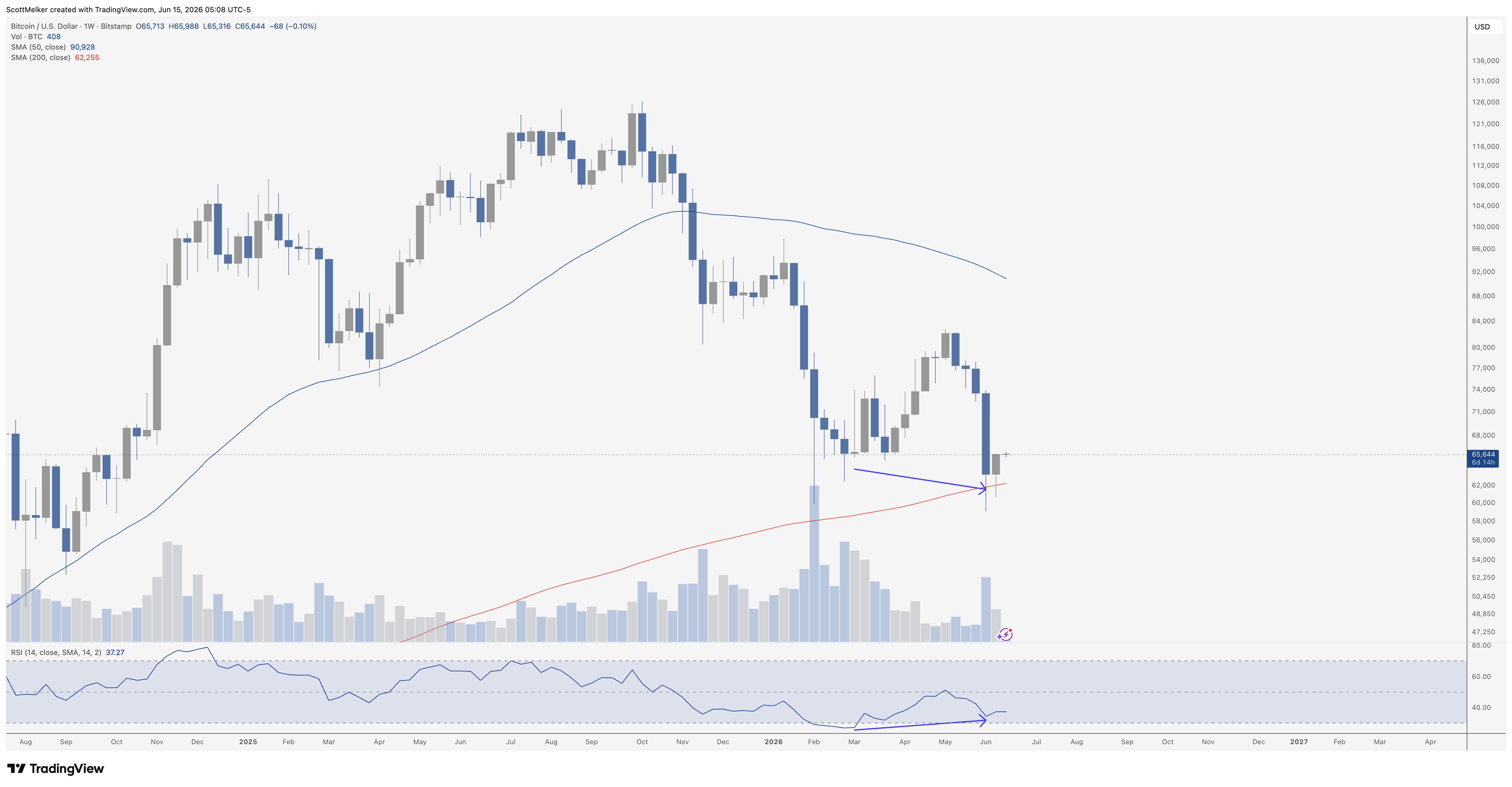
Last time I shared charts, it was to make the argument that Bitcoin was likely “bottoming.” This was based on multiple ideas, notably that price was visiting the 200 weekly MA for the 4th time in history. It has only traded below it for more than a week in 2022, after FTX (9 months). We also had oversold conditions here for the 4th time ever, all bottoms. For the second time ever, we now have bullish divergence coming out of oversold RSI on the weekly chart.
Since we last spoke, we have 2 candles wicking below the 200 MA and closing above, all while sentiment is in the dumps and narrative about complete collapse are rampant.
I remain cautiously optimistic that the the path is up.

SBF Just Lost His Appeal And The Pardon Is His Only Path Left
Appeals court upholds FTX co-founder Sam Bankman-Fried’s fraud conviction
The 2nd Circuit Court of Appeals unanimously upheld Sam Bankman-Fried’s fraud conviction and 25-year sentence on Friday, calling the prosecution’s evidence “robust.” The ruling closed his last legal path the same week he filed a presidential pardon petition with Trump. The pardon math is now the only math that matters.
Mastercard Just Built A Payment Rail For AI Agents
Mastercard Launches Agent Pay for Machines to Unlock Super-Fast, Always-On Payments
Mastercard launched Agent Pay for Machines (AP4M) on June 10, a payment network for autonomous AI agents to transact at machine speed. The launch included 30+ partners including Coinbase, Ripple, Stripe, and OKX, with credentials recorded on Polygon, Solana, and Base. The machine economy now has card-network rails.
Blockworks Just Bought Messari At 95 Percent Off
Blockworks Acquires Messari In Deal Highlighting Crypto’s Data Consolidation Race
Blockworks acquired Messari on Friday for just over $10M according to WSJ — a 95% discount from Messari’s $300M valuation in its 2022 Series B. The deal combines crypto’s two largest data platforms and signals broader industry consolidation as crypto M&A has hit 144 deals worth $11.8B year to date.

Bitcoin Just Got A $4 Trillion Catalyst - Carlos Domingo
My Platforms And Sponsors
Arch Public - It’s a hedge fund in your pocket. Built for retail traders, designed to outperform Wall Street. Try emotionless algorithmic trading at Arch Public today.
Promote your brand with The Wolf of All Streets. For sponsorship and partnership opportunities, contact info@thewolfofallstreets.io.
The Wolf Pack - My Telegram group where I share daily market updates, real-time observations, and ongoing discussions with the community. There’s a dedicated channel and group chat, and it’s completely free to join.
The Crypto Advisor - My weekly newsletter for registered investment advisors, combining macro trends, Wall Street insights, and crypto – all in one place..
X - I spend most of my time on X, contributing to CryptoTownHall every weekday morning, sharing random charts, and responding to as many of you as I can.
YouTube - Home of the Wolf Of All Streets Podcast and daily livestreams. Market updates, charts, and analysis!
The views and opinions expressed here are solely my own and should in no way be interpreted as financial advice. Every investment and trading move involves risk. You should conduct your own research when making a decision. I am not a financial advisor. Nothing contained in this e-mail constitutes or shall be construed as an offering of financial instruments or as investment advice or recommendations of an investment strategy or whether or not to "Buy," "Sell," or "Hold" an investment.
Thanks for reading The Wolf Den! Subscribe for free to receive new posts and support my work.
For the bitcoin miners, that's the good thing: they already left the field and moved to AI because it's highly profitable for them with the energy and their long-term contracts.
Yes, because the miners get more money for their Energy in the AI sector —> good move…