
Circle Stock Is Surging Alongside The Stablecoin Economy
USDC growth, regulatory momentum, and AI-powered payments are turning Circle into one of Wall Street’s favorite crypto infrastructure trades.
Circle is rapidly turning into one of the most closely watched companies in the entire crypto industry, and not because of Bitcoin speculation or a meme coin mania. Investors are increasingly viewing the company as something much larger: a direct bet on the growth of the stablecoin economy itself. That narrative gained even more momentum after Circle’s latest earnings report showed USDC circulation climbing sharply, on-chain transaction volume exploding into the trillions, and management unveiling an aggressive push into AI-powered payment infrastructure.
At the same time, Circle appears uniquely positioned to benefit from Washington’s accelerating regulatory push around stablecoins. As lawmakers move closer to advancing the CLARITY Act and other stablecoin legislation, the company’s long-standing focus on compliance, Treasury-backed reserves, and institutional partnerships is starting to look less like a limitation and more like a competitive advantage. In other words, while much of crypto spent years trying to avoid regulation, Circle may end up becoming one of its biggest beneficiaries.
Watch The Daily Wolf – LIVE on Yahoo Finance
The Daily Wolf is the only daily crypto show ever to air on mainstream financial news. No guests, no fluff, no endless chart drawings – just me, live on Yahoo Finance every weekday at 12pm ET, finding signal in the noise and ranting for 15 minutes about what actually matters in crypto and markets.
If you want the unfiltered version of what makes it into this newsletter – tune in.
Watch LIVE every weekday at 12pm ET on Yahoo Finance
Catch the full archive of past episodes HERE
Circle’s rise has been years in the making, even if much of Wall Street is only beginning to pay attention now. The company was founded in 2013 by Jeremy Allaire and Sean Neville, originally with ambitions far broader than simply issuing a stablecoin. In its early years, Circle experimented with crypto payments, peer-to-peer transfers, and trading services before gradually focusing on what would become its most important product: blockchain-based dollars that could move instantly across the internet. That product eventually became USDC.
At the time, stablecoins were still a relatively niche corner of crypto primarily used by traders moving between exchanges. Tether dominated the market, but concerns around transparency and reserve backing consistently followed the company. Circle saw an opening to build something different: a regulated, institutionally friendly stablecoin backed by short-duration U.S. Treasuries and cash equivalents. In 2018, Circle partnered with Coinbase to launch the Centre Consortium and formally introduced USDC.
Over the next several years, decentralized finance exploded, crypto trading volumes surged, and dollar-backed stablecoins quietly became some of the most heavily used assets on blockchain networks. Traders used them for liquidity, DeFi protocols used them for lending and collateral, and international users increasingly relied on them for cross-border transfers and dollar access. Entire crypto ecosystems slowly began running on tokenized dollars, moving 24/7 across blockchain rails.
That growth dramatically reshaped Circle itself. USDC circulation expanded from under $1 billion in 2020 to more than $55 billion during the peak of the 2021 bull market before temporarily contracting during the brutal 2022 collapse. The Terra implosion triggered widespread panic around stablecoins, while the failures of Celsius, Voyager, Three Arrows Capital, and FTX severely damaged confidence across the industry. Then, in March 2023, Circle faced one of the biggest crises in its history when roughly $3.3 billion of reserves backing USDC became temporarily trapped inside Silicon Valley Bank during the regional banking crisis.
For a brief period, the market genuinely questioned whether USDC itself might break. The stablecoin lost its dollar peg and briefly traded below $0.90 as traders rushed to exit positions across crypto markets. But Circle ultimately survived the panic after U.S. regulators guaranteed SVB depositors, restoring confidence in the reserves backing the token. Rather than disappearing alongside many other crypto firms from that era, Circle emerged from the crisis with a stronger institutional focus on reserve transparency, Treasury holdings, and regulatory oversight.
Now, several years later, the company appears to be entering an entirely different phase of growth. What makes Circle especially interesting right now is that its expansion is no longer being driven purely by speculative crypto trading activity. During the first quarter, USDC circulation climbed 28% year-over-year to $77 billion, while USDC on-chain transaction volume exploded 263% to an astonishing $21.5 trillion. Circle also said USDC represented 63% of stablecoin transaction volume during the quarter, despite Tether still maintaining the larger overall supply.
Those are the kinds of numbers that start making Wall Street view stablecoins less as a niche crypto product and more as an emerging payments network operating at internet scale. Importantly, this activity is increasingly coming from outside traditional crypto speculation. Stablecoins are now being integrated into payment systems, fintech applications, remittance networks, tokenized asset platforms, and even experiments happening inside traditional finance itself. What once looked like a niche crypto utility increasingly resembles a global internet-native payments layer operating around the clock, and Circle sits directly at the center of that transformation.
Part of the reason Circle stock has attracted so much attention recently is that the company appears unusually well-positioned for the regulatory direction Washington is now moving toward. For years, one of the biggest concerns hanging over stablecoins was the lack of clear federal rules surrounding reserves, disclosures, licensing requirements, and oversight. That uncertainty made it difficult for many large financial institutions to fully engage with the sector, even as stablecoin usage continued to explode globally.
Now, that landscape may finally be starting to change. The newly released draft of the CLARITY Act, alongside other stablecoin-focused legislation moving through Congress, signals that lawmakers are becoming increasingly serious about building a formal framework around digital dollar infrastructure. While the legislation still faces a long path forward, the broader message coming from Washington is becoming harder for markets to ignore: stablecoins are no longer being treated purely as speculative crypto products, but as a financial category regulators are actively preparing to integrate into the system.
Circle spent years building its business around the assumption that regulation would eventually arrive. Unlike many offshore issuers that prioritized speed and lighter oversight, Circle leaned heavily into compliance, reserve transparency, and institutional partnerships from the very beginning. USDC reserves are primarily backed by short-duration U.S. Treasuries and cash equivalents, with the company regularly publishing attestation reports and maintaining close relationships with traditional banking infrastructure. In many ways, Circle operated less like a typical crypto startup and more like a financial institution running on blockchain rails.
As a result, investors increasingly see a scenario where tighter stablecoin regulation could actually strengthen Circle’s competitive position rather than hurt it. If legislation ultimately imposes stricter reserve requirements, licensing standards, and compliance obligations, the barriers to entry for smaller or offshore competitors could rise significantly. That could push more institutional capital, fintech integrations, and enterprise payment activity toward firms already operating within those guardrails. In other words, while large parts of crypto spent years trying to avoid regulation entirely, Circle may be emerging as one of the clearest examples of a company that quietly prepared for this exact environment long before Washington caught up.
Another major driver behind Circle’s recent momentum has been its increasingly aggressive push into AI-focused financial infrastructure. During its latest earnings report, management repeatedly discussed what it described as an “agentic economy,” referring to a future where autonomous AI systems can transact directly with each other using blockchain-based payments. Circle has started building products specifically designed for that environment, including Agent Wallets, Agent Marketplace, and a nanopayments system intended to support extremely small, automated transactions between software agents.
The company is essentially positioning stablecoins as the payment layer for machine-driven internet activity. Traditional payment systems are often too slow or too expensive for high-frequency automated transactions, particularly when dealing with micropayments or cross-border activity. Circle argues that blockchain-based dollars can solve many of those limitations by allowing AI systems to move value instantly over internet-native rails without relying on traditional banking hours or card networks.
Circle also recently raised roughly $222 million through a presale tied to ARC, the token powering its upcoming Arc blockchain network. According to the company, Arc is being designed around stablecoin settlement, programmable finance, and AI-native payment infrastructure. While much of this strategy is still early, investors appear increasingly interested in the possibility that Circle could sit at the intersection of two major technology trends simultaneously: stablecoin adoption and autonomous AI commerce.
Circle’s recent rise reflects something larger than a typical crypto rally. Investors are increasingly betting that stablecoins are evolving into a legitimate layer of global financial infrastructure, and Circle has spent years positioning itself directly at the center of that trend. Between the rapid growth of USDC, improving regulatory momentum in Washington, and the company’s push into AI-driven payment systems, markets are beginning to view Circle less as a speculative crypto company and more as a long-term infrastructure play tied to how money may eventually move across the internet.

The Clarity Act Has Been Released For Markup!
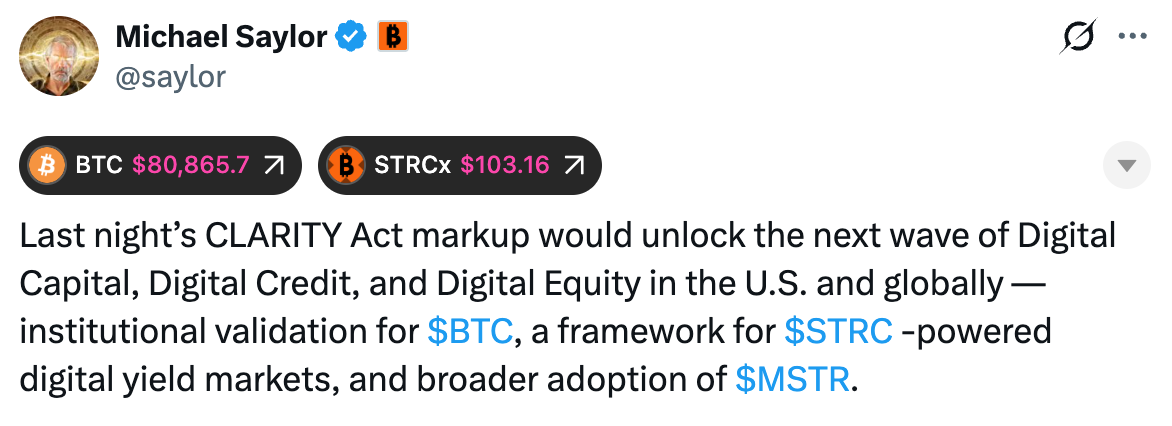
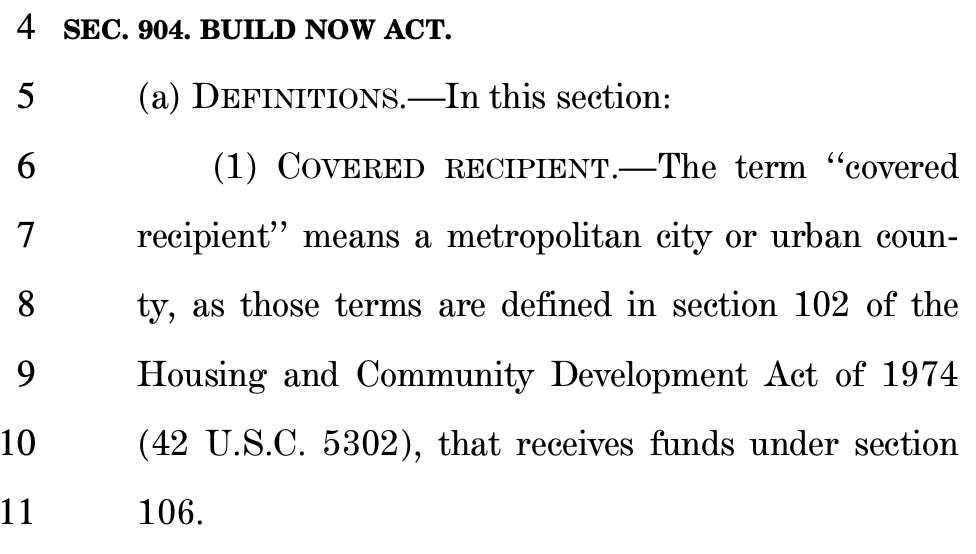
The CLARITY Act is finally here, and by the time you are reading this, committee members will likely be working diligently to finish their final edits before the bill heads into a vote on Thursday. Fingers crossed, because getting this across the finish line is still shaping up to be a nail-biter. There is also, somewhat bizarrely, an entire nine-page section about housing tacked onto the end of the draft - see below.
OKX Is Giving Away XRP!

OKX has a new XRP promotion running right now where users can earn up to $100 in XRP by completing a five-day buy streak. The campaign starts with a simple $10 crypto purchase to unlock the first $10 XRP reward, followed by four additional days of $200+ purchases in eligible crypto assets to unlock the remaining rewards.
One important detail is that all five purchases must be completed by May 18, meaning users realistically need to start as soon as possible to leave enough time to finish the streak. Missing a day will reset the streak progression, although users will still keep their initial Day 1 reward.
Roaring Kitty’s X Account Hacked in $1M Solana Meme Coin Rug Pull
Hackers briefly took control of Roaring Kitty’s X account to promote a fake Solana meme coin, triggering a rapid buying frenzy from retail traders. The token’s market cap exploded to roughly $12 million before collapsing more than 76% as insiders dumped their holdings. Blockchain data suggests the attackers extracted around $1 million before the posts were removed.
JPMorgan Moves Deeper Into Crypto With Ethereum-Based Treasury Fund
JPMorgan has filed to launch a tokenized money market fund on Ethereum, backed entirely by U.S. Treasuries, marking another major step by traditional finance into blockchain-based assets. The fund will operate through JPMorgan’s Kinexys Digital Assets platform using a permissioned system built on top of Ethereum, with potential expansion to other chains later. The move adds to the growing wave of tokenized treasury products from major financial institutions entering the crypto infrastructure.

Bitcoin Can’t Break $82K - Will CLARITY Change That Thursday?
Bitcoin is testing its 200-day SMA near $82K as the Senate Banking Committee drops a 309-page CLARITY Act draft ahead of Thursday’s pivotal May 14 markup vote — a moment that could redefine US crypto policy and unlock the next institutional wave. With $858M flooding into crypto funds last week, Saylor unveiling a $2.2B tax-loss harvesting playbook, and Wall Street giants like BlackRock, Apollo, and a16z pouring hundreds of millions into Circle’s Arc and Canton Network, the setup is loaded. Add Morgan Stanley triggering a crypto fee war on E*Trade, Ray Dalio warning central banks won’t touch Bitcoin, and the Iran-driven oil shock rattling markets — and you’ve got one of the most consequential weeks of the cycle. Is the breakout finally here?
🎙 Guests
My Platforms And Sponsors
Arch Public - It’s a hedge fund in your pocket. Built for retail traders, designed to outperform Wall Street. Try emotionless algorithmic trading at Arch Public today.
Promote your brand with The Wolf of All Streets. For sponsorship and partnership opportunities, contact info@thewolfofallstreets.io.
The Wolf Pack - My Telegram group where I share daily market updates, real-time observations, and ongoing discussions with the community. There’s a dedicated channel and group chat, and it’s completely free to join.
The Crypto Advisor - My weekly newsletter for registered investment advisors, combining macro trends, Wall Street insights, and crypto – all in one place..
X - I spend most of my time on X, contributing to CryptoTownHall every weekday morning, sharing random charts, and responding to as many of you as I can.
YouTube - Home of the Wolf Of All Streets Podcast and daily livestreams. Market updates, charts, and analysis!
The views and opinions expressed here are solely my own and should in no way be interpreted as financial advice. Every investment and trading move involves risk. You should conduct your own research when making a decision. I am not a financial advisor. Nothing contained in this e-mail constitutes or shall be construed as an offering of financial instruments or as investment advice or recommendations of an investment strategy or whether or not to "Buy," "Sell," or "Hold" an investment.
Thanks for reading The Wolf Den! Subscribe for free to receive new posts and support my work.