
On yesterday’s Macro Monday, Mario Innecco brought up a decision Jimmy Carter made that I can’t imagine either party making today: he appointed a Fed chairman after being warned it could cost him reelection. Mike McGlone called it “a complete profile in courage.” With the midterms today, I went back through the history, because that choice feels almost foreign to the politics we have now.
Today could change who controls Congress. I don’t expect it to produce a party willing to accept years of economic pain for a payoff somebody else gets to claim. Trump is demanding lower rates, and I think the pressure for easier money would survive a change of party. Neither has earned my confidence on fiscal responsibility. Whoever wins, I expect more promises, more borrowing and, eventually, more money creation. Carter’s experience helps explain why.
Paul Volcker told Carter what he intended to do before accepting the job. During his interview, he said he favored tighter policy than the sitting Fed chairman. Bert Lance warned the White House that appointing Volcker would mortgage Carter’s reelection to the Federal Reserve. The risk was explicit. Carter was choosing someone who intended to make borrowing more expensive, knowing voters might judge him before that policy delivered its benefits.
Today’s newsletter is brought to you by Ledn - Hard Assets. Higher Standards.

Building your position took discipline. Your lender should have the same discipline.
Ledn brings that same discipline to bitcoin-backed loans, giving you liquidity for your next move, funded in hours, not days, without selling your bitcoin.
Your collateral is custodied and never lent out for interest
Every month, Ledn publishes its Open Book Report, with all metrics independently reported
Hard assets. Higher standards. Get 0.25% off the APR on your first loan at ledn.io/wolf.
Paid partnership. Terms apply. Availability varies by jurisdiction. Digital asset lending involves risk, including loss of collateral.
That is how the timing worked out. The economy went into recession in 1980, and the fed funds rate was back at 15.9% in November, when Carter lost in a landslide. He called a Fed increase “ill advised” a month before the vote, but Volcker remained in the job and the tightening continued. Rates rose further after Carter left, before inflation fell to 2.5% by July 1983. The political cost arrived before the economic reward. Reagan was president when the reward came.
Carter’s defeat had plenty of causes, and his record deserves scrutiny. His own credit controls helped cause the downturn, while the Iran hostage crisis and Ted Kennedy’s primary challenge also figured in the result. Volcker wasn’t even his first choice, and calming markets was part of the reason for the appointment. I can acknowledge all of that and still respect the decision. Carter received a warning about the personal consequences and hired Volcker anyway.
What happened under Reagan makes the election incentive even clearer. Before the 1984 vote, with Reagan sitting silently beside him, chief of staff James Baker told Volcker, “The president is ordering you not to raise interest rates before the election.” The administration that benefited from inflation coming down wanted protection from another increase when its own future was on the ballot. Changing parties hadn’t changed the calculation.
That calculation is familiar today. Trump demanded rates of “1%, or less” after the Fed raised them in September, when inflation was 3.7%. The Fed’s willingness to raise rates deserves credit, but I see little reason to expect politicians themselves to embrace restraint. Lower rates and money creation are different decisions, just as government spending and central banking are different responsibilities. The incentive running through them is familiar: offer relief now and leave the cost for later. I don’t trust either party to consistently resist it.
That is why Bitcoin matters to me. Its supply is capped at 21 million on a fixed issuance schedule, so continuing that restraint doesn’t require finding another president willing to accept Carter’s risk. Today’s winners will have spending promises to fulfill and another election ahead of them. I expect the pressure for easier money to continue, whichever party celebrates. My reason for valuing Bitcoin is that its supply schedule doesn’t depend on the winners becoming responsible with money.
Hit reply and tell me which part of today’s fight over rates you want me to dig into next. If this landed in Promotions or Spam, move it to Primary while you’re here.

Interest Rates and Inflation Around Carter’s Defeat
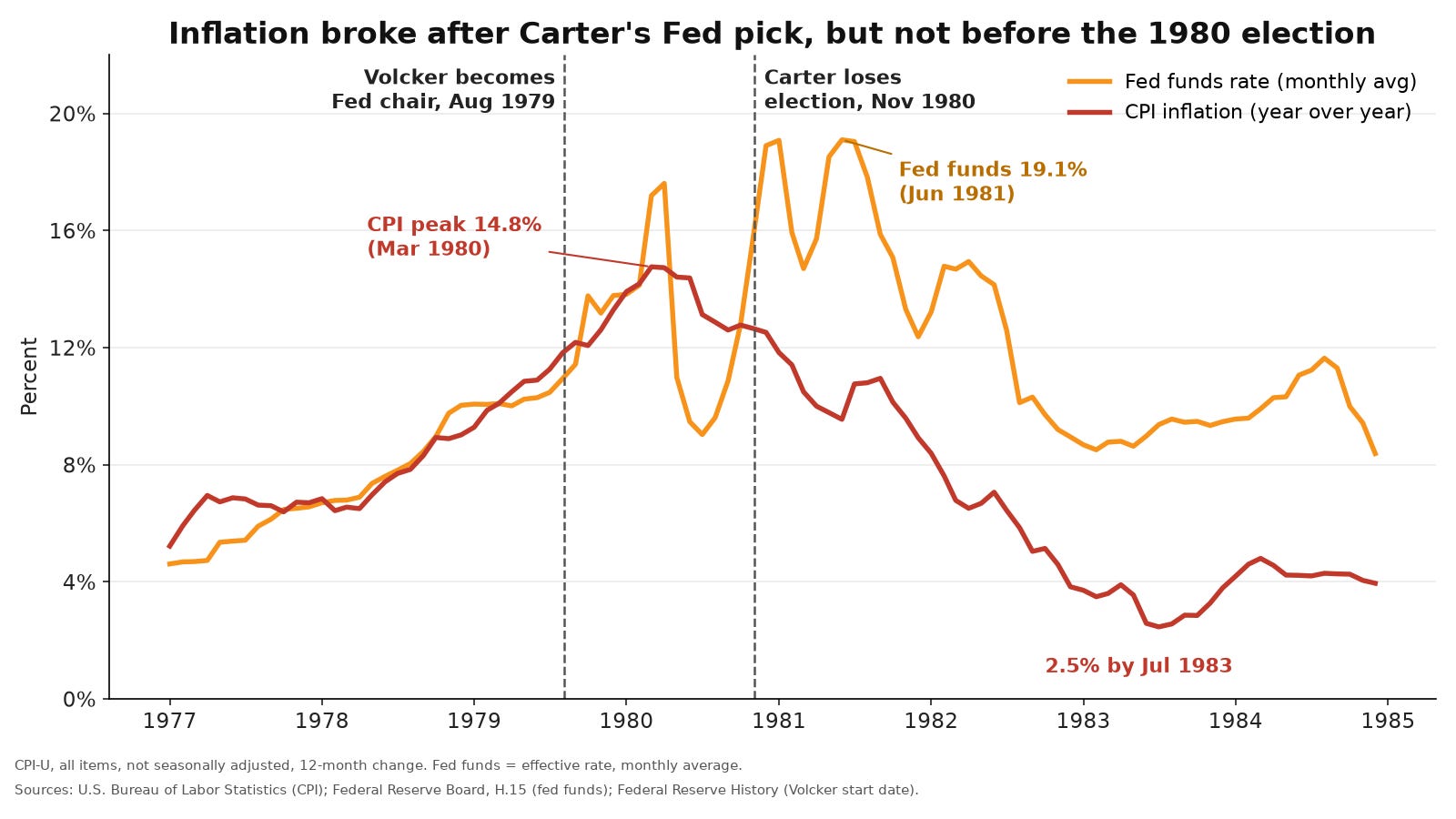
The fed funds rate climbed back to 15.9% in the month Carter lost, then averaged 19.1% the following June. CPI inflation was down to 2.5% by July 1983, with Reagan in the White House.
Takeaway: Bitcoin’s supply schedule does not depend on politicians accepting the electoral cost of tighter money.
Sources: U.S. Bureau of Labor Statistics (CPI); Federal Reserve Board, H.15 (fed funds); Federal Reserve History (Volcker start date).

OKX Launches a Stablecoin Card in the US
OKX launched a WebBank-issued virtual Mastercard in the US yesterday, letting eligible customers spend against USDC, USDT and USDG held in OKX Pay without converting them to dollars first. It works with Apple Pay and Google Pay, with no transaction or foreign exchange fees on purchases. Cashback ranges from 2% to 10% on eligible USDG purchases and requires Autopay repayment. The top tier requires a $500,000 balance, $100,000 in monthly spending or VIP 4 status, with rewards capped at $18,000 a year. The card is unavailable in New York, Massachusetts and US territories, and follows launches in Europe in January and select South Asian and African markets in July.
Takeaway: Stablecoins are becoming easier to spend through familiar payment networks, but the highest cashback rate has steep requirements.
Binance Publishes Its First Proof of Reserves Since the Hack
Binance published its first post-hack proof of reserves yesterday, using an October 31 snapshot covering BTC, ETH, USDT, BNB, SOL, USDC, XRP, USD1, RLUSD and ZEC. The zero-knowledge proof lets holders verify 1:1 backing for covered assets; Binance’s page lists BTC at 100.04% and ETH and USDT at 100.00% each. Binance says it has replaced about 95% of the stolen assets with its own funds and is still buying the less-liquid tokens making up the remaining 5%. More networks and assets are scheduled to begin reopening for withdrawals today, and a broader snapshot is due tomorrow, November 4. This is a dated snapshot of the covered assets, rather than a financial-statement audit.
Takeaway: Customers now have a way to verify backing for the listed assets, while the recovery remains unfinished.
Mercado Bitcoin Halts Withdrawals After About $46 Million Is Stolen
Mercado Bitcoin, Brazil’s largest crypto exchange, paused deposits and withdrawals yesterday after about $46 million was drained from wallets on at least 10 blockchains, according to Arkham data. The funds moved through ordinary transfers rather than a smart-contract exploit, and how the attacker gained signing access remains unknown. The exchange said it “identified and swiftly contained” the incident and that customers weren’t harmed, but CertiK researcher Dickson Wu disputes that, saying funds left customer deposit addresses and kept moving hours after the pause. Tether froze about $4.5 million in USDT. The exchange has about 4.5 million customers, and there is no attribution or public evidence linking the attack to the Binance hack.
Takeaway: Customer impact remains disputed, and the exchange has yet to explain how the attacker gained signing access.

Bitcoin Faces Its Toughest Macro Test Of 2026
My Platforms And Sponsors
Arch Public - It’s a hedge fund in your pocket. Built for retail traders, designed to outperform Wall Street. Try emotionless algorithmic trading at Arch Public today.
Promote your brand with The Wolf of All Streets. For sponsorship and partnership opportunities, contact info@thewolfofallstreets.io.
The Wolf Pack - My Telegram group where I share daily market updates, real-time observations, and ongoing discussions with the community. There’s a dedicated channel and group chat, and it’s completely free to join.
X - I spend most of my time on X, contributing to CryptoTownHall every weekday morning, sharing random charts, and responding to as many of you as I can.
YouTube - Home of the Wolf Of All Streets Podcast and daily livestreams. Market updates, charts, and analysis!
The views and opinions expressed here are solely my own and should in no way be interpreted as financial advice. Every investment and trading move involves risk. You should conduct your own research when making a decision. I am not a financial advisor. Nothing contained in this e-mail constitutes or shall be construed as an offering of financial instruments or as investment advice or recommendations of an investment strategy or whether or not to "Buy," "Sell," or "Hold" an investment.
Thanks for reading The Wolf Den! Subscribe for free to receive new posts and support my work.
You say "eventually, more money creation." It's been happening for a year, so the test has already run.
M2 went from $22.3tn in October 2025, when bitcoin peaked, to $23.3tn in August. That's about $1tn of new money, and since January it has grown near 7% annualized. Over roughly the same stretch bitcoin's market cap fell by about $960bn, from 11.3% of M2 to 6.7%. An asset bought as protection against money creation lost about as much as the money supply gained.
Look at how it happened too. M2 sped up this year without the Fed cutting once. The money isn't waiting on a chairman, it's mostly coming from deficits and bank lending, so I'm not sure the Carter question decides this. You could find a Volcker tomorrow and the Treasury would still be borrowing.
What bitcoin seems to follow instead is the dollars inside crypto. USDT plus USDC peaked around $267bn in April and is about $250bn now, shrinking while M2 grows.
Ten months is short and this doesn't kill the long-term case. But a hedge needs a test it can fail. If a year of 5-6% M2 growth and a 39% drawdown doesn't count, what would?